The Belt and Road Forum: a new way forward
- By Sabena Siddiqui
0 Comment(s)
Print
E-mailChina.org.cn, May 10, 2017
Adjust font size: 

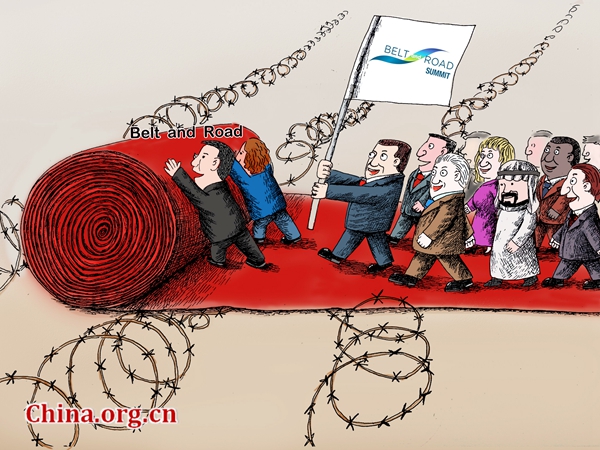 |
The upcoming Belt and Road Forum for International Cooperation will serve as a powerful reminder of the Belt and Road project’s dedication to win-win international development. [Zhang Xueshi/China.org.cn]
|
The forum promises to be the biggest diplomatic event of the year, with greater attendance than both the NATO and the upcoming EUCO summits. The audience of 1,200 people includes UN Secretary-General Antonio Guterres, World Bank President Jim Yong Ki, and Managing Director of the International Monetary Fund Christine Lagarde. The summit will have the world's attention, and general perception of the event was aptly described by Bruno Macaes, a partner at the London-based consultancy firm Flint Global, when he said, "I think it's a very important event and occasion, and in some respects, it is becoming as important as the G20 summit."
Undoubtedly, the Belt and Road Forum is a significant event from an economic, political and geopolitical perspective. It also marks China's emergence as a global leader with its own large initiatives. As a global policy co-ordination platform, it is quite similar to the G20 summit. Furthermore, it has also been positively assessed by the United Nations General Assembly, the UN Security Council and APEC resolutions and documents. A clearer road-map of the initiative will emerge as more agreements for joint projects are signed between China and the participating countries and organizations at the event.
The central theme of the event is "Boosting Cooperation and Realizing Win-Win Development," a concept that is meant to promote cooperation between developing and developed countries through enhanced connectivity, added infrastructure, job creation and poverty reduction.
Nevertheless, Chinese Foreign Minister Wang Yi stresses, "This is an economic initiative and it deals with economic cooperation, so we do not want it to be politicized." He also added that, "The Belt and Road is, to date, the most important public good China has given to the world."
Significantly, China's long-term objective is to discourage protectionism at a time when most Western powers are in the process of retreating into isolationism. China's Belt and Road Initiative provides a viable alternative that focuses on globalization of the economy and a spirit of openness. Having said that, providing a chance for emerging economies to benefit from improved infrastructure and increased global trade does enhance China's leadership role as it puts many nations on the road to progress.
Recently, Vina Cheung, global head of RMB Internationalization at HSBC, discussed the financial aspect of the Initiative and China's full integration with the global economy. "There is the physical, which is the infrastructure. The financial in terms of lending and capital raising, and policy cooperation between the countries along the Belt and Road." The enhanced usage of the RMB will accelerate its internationalization; even now it is the sixth global payment currency and fifth most widely traded in foreign exchange markets.
In addition, Zhou Xiaochuan, governor of the People's Bank of China, has also suggested that local currencies be used instead of dollars or other major currencies for all Belt and Road Initiative (BRI) investments to help ensure financial stability of BRI nations and reduce risk from exchange-rate fluctuations.
The Belt and Road Initiative holds great potential even for the United States, as Chinese investment can boost American industries and provide jobs and new market opportunities. Such a collaboration would be a win-win solution for both global powers. The only impediment is the mistrust shown by scholars and critics in the U.S. that take the Initiative as the equivalent of a Chinese Marshall Plan. This wait-and-watch attitude has prevented the U.S. from benefiting from a venture that is the perfect new platform for Sino-U.S. collaboration.
Meanwhile, the Belt and Road Initiative is moving ahead as work progresses in transport, energy and communication projects, such as the China-Pakistan Economic Corridor, China Railway Express trains to Europe and the Padma Bridge in Bangladesh. Encouragingly, China's trade with economies along the Belt and Road routes achieved double digit growth year-on-year in the first quarter of the year according to the Chinese Ministry of Commerce.
Sabena Siddiqui (Twitter: @sabena_siddiqi) is a foreign affairs journalist and lawyer based in Pakistan.
Opinion articles reflect the views of their authors, not necessarily those of China.org.cn.

Go to Forum >>0 Comment(s)
No comments.


Very interesting,good job and thanks for sharing such a good blog. You’re doing a great job.Keep it up
ReplyDeleteForex Trading
Forex Trading
Forex Trading
Forex Trading